
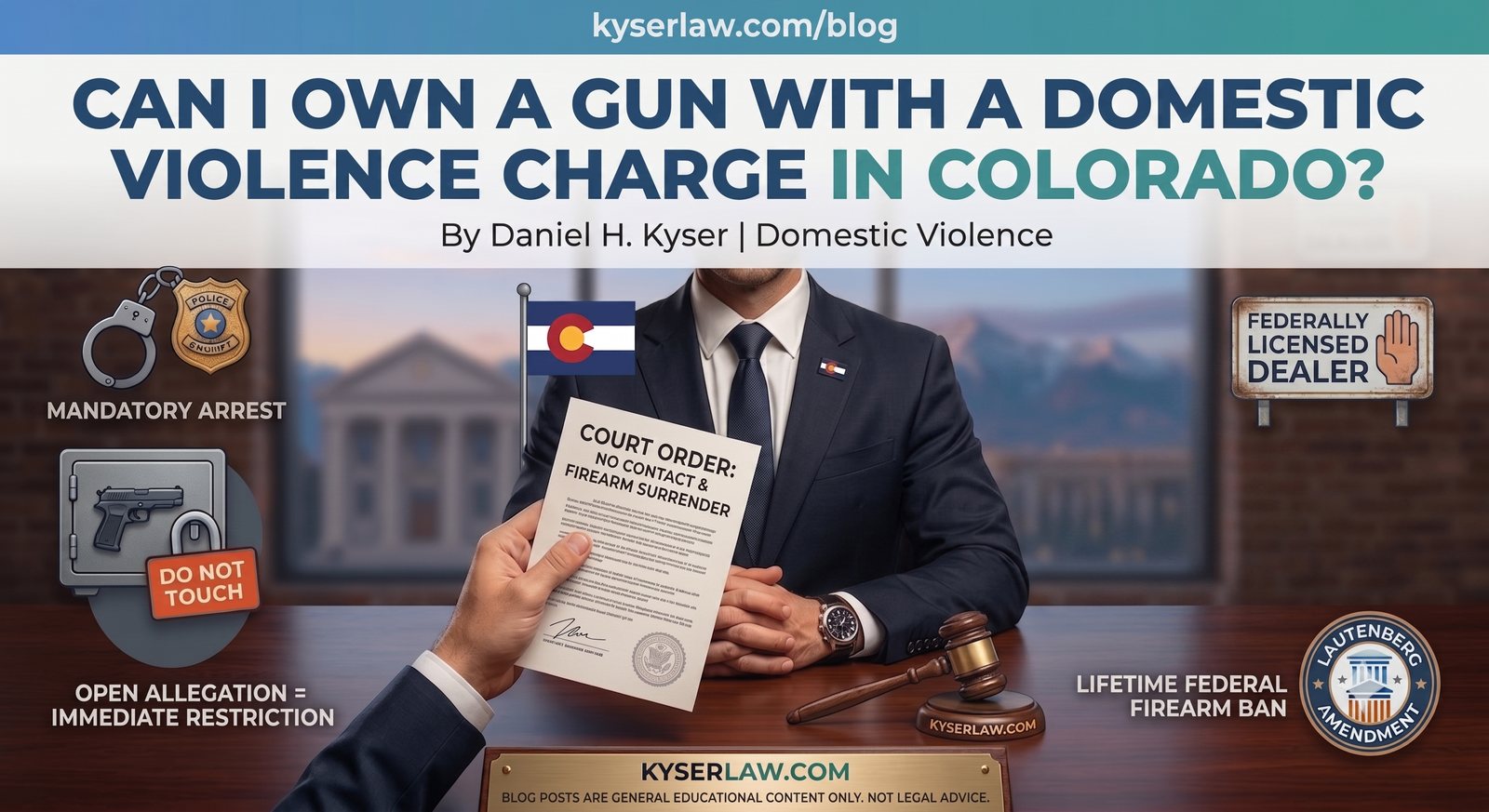
The short answer is almost always no. In Colorado, if you have an open domestic violence allegation, you are not allowed to possess a firearm, and that restriction attaches long before anyone has decided whether you did anything wrong. Colorado defines domestic violence broadly at C.R.S. section 18-6-800.3, reaching not only an act or threatened act of violence against an intimate partner but any crime used as a method of coercion, control, punishment, intimidation, or revenge.
Domestic violence is a mandatory-arrest situation in Colorado. Once officers respond, someone is going to jail. (For why that happens even when the alleged victim does not want it, see Colorado's Mandatory Arrest Law: What It Really Means.) Before you can be released, the court must issue a no-contact order, otherwise known as a mandatory protection order, which Colorado requires as a condition of release in every domestic violence case (C.R.S. section 18-1-1001). You will also be ordered to give up any firearm in your possession and to certify to the court that you have done so. The surrender is a condition of your release, and the certification must be filed within the short deadline the court sets.
This is a broad rule, and it applies to everyone with a pending DV charge. It can be especially harsh on people who carry a firearm for their job, including law enforcement, security, military, and others who are required to be armed. The law does not care that you need it for work. It does not care that losing it may cost you your job. You still cannot have it.
How You Are Allowed to Relinquish a Firearm
Colorado law recognizes only a few lawful ways to give up your firearms while a case is pending. Doing it the wrong way, such as handing the gun to a roommate, hiding it, or simply keeping it, is its own criminal problem.
Sell or transfer it to a federally licensed firearms dealer (an FFL). The most straightforward option is to sell the firearm outright to a gun store or another federally licensed dealer.
Have law enforcement store it. You can ask your local law enforcement agency to hold the firearm while the case is pending, and you are responsible for any storage fees. Be aware that Colorado law allows a law enforcement agency to store firearms, but it does not require them to. Most local police departments do not offer this service, so do not assume it will be available.
Transfer it to a private third party. You can transfer the firearm to a friend or family member who does not live with you and who will keep it away from your home for the duration of the case. This route has a catch. The transfer requires a federal firearms background check on the person receiving the gun. You can usually have a gun store or licensed dealer run that check for a fee. The fee varies, so it is worth calling a few places to compare availability and pricing. Once the check is done, you must certify to the court that the background check was performed.
What Happens if You Are Convicted
Everything above applies while the case is merely pending. A conviction is far worse, and often permanent.
If you are convicted of a qualifying domestic violence offense, the federal firearm ban kicks in under the Lautenberg Amendment, 18 U.S.C. section 922(g)(9). That is a lifetime, nationwide bar on possessing a firearm or ammunition. Not five years, not ten, but for the rest of your life. A misdemeanor plea that carries no jail time and looks like a bargain at arraignment can quietly cost you your Second Amendment rights forever. I explain how that trap works, and how careful plea negotiation can sometimes avoid it, in How a Colorado Domestic Violence Conviction Can Cost You Your 2nd Amendment Rights, Permanently.
One point that surprises many clients: in Colorado, the judge, not the jury, decides whether your conduct counted as an act of domestic violence for sentencing purposes. That single finding is what pulls the firearm consequences into your case. I break down why that is, and what it means for your defense, in Who Decides Whether You Committed Domestic Violence in Colorado, Judge or Jury?.
Talk to a Colorado Domestic Violence Attorney Before You Act
Your gun rights can be affected the moment you are charged and lost for life if you are convicted of the wrong offense. Those stakes are too high to navigate alone or to leave to inexperienced counsel.
Questions About Guns and a Pending Colorado DV Charge
Can I own a gun while I have a pending domestic violence charge in Colorado?
Almost always no. In Colorado, if you have an open domestic violence allegation you are not allowed to possess a firearm, and that restriction attaches long before anyone has decided whether you did anything wrong. Surrendering your firearms and certifying that you have done so is a condition of your release.
What are the lawful ways to relinquish a firearm in a Colorado DV case?
Colorado recognizes only a few lawful methods: sell or transfer the firearm to a federally licensed firearms dealer (an FFL); ask a law enforcement agency to store it while the case is pending (agencies are allowed but not required to do so, and most do not); or transfer it to a private third party who does not live with you, which requires a federal firearms background check on the person receiving the gun. You must then certify to the court that you relinquished the firearm in one of these prescribed ways.
What happens if I do not give up my firearms the right way?
Handing the gun to a roommate, hiding it, or simply keeping it is its own criminal problem. If you do not relinquish every firearm in one of the prescribed ways, the court can revoke your bond and hold you in jail until the case is resolved.
I carry a firearm for my job. Does the rule still apply to me?
Yes. The rule applies to everyone with a pending DV charge, including people who carry a firearm for work such as law enforcement, security, and military. The law does not care that you need it for your job or that losing it may cost you that job. You still cannot possess it while the case is pending.
Does a Colorado domestic violence conviction affect my gun rights permanently?
It can. If you are convicted of a qualifying domestic violence offense, the federal firearm ban under the Lautenberg Amendment, 18 U.S.C. section 922(g)(9), applies. That is a lifetime, nationwide bar on possessing a firearm or ammunition. A misdemeanor plea that carries no jail time can quietly cost you your Second Amendment rights for the rest of your life.
Protect Your Firearm Rights — Talk to Daniel Today
If you are facing a domestic violence charge in Colorado and are worried about your firearms, speak with Daniel before your next court date.
Call 303-831-6111 for a free, confidential consultation, or request a case evaluation online. Learn more about our Colorado domestic violence defense practice.
Law Office of Daniel H. Kyser — 5950 S. Willow Drive, Suite 250, Greenwood Village, CO 80111. Serving Denver, Arapahoe, Jefferson, Douglas, and Adams counties.
